Art, Invention & Natural Philosophy
Leonardo da Vinci
Artist · Inventor · Engineer · Anatomist · Natural Philosopher
1452–1519
The Art of Seeing
Explore Legacy Teachings Research & Sources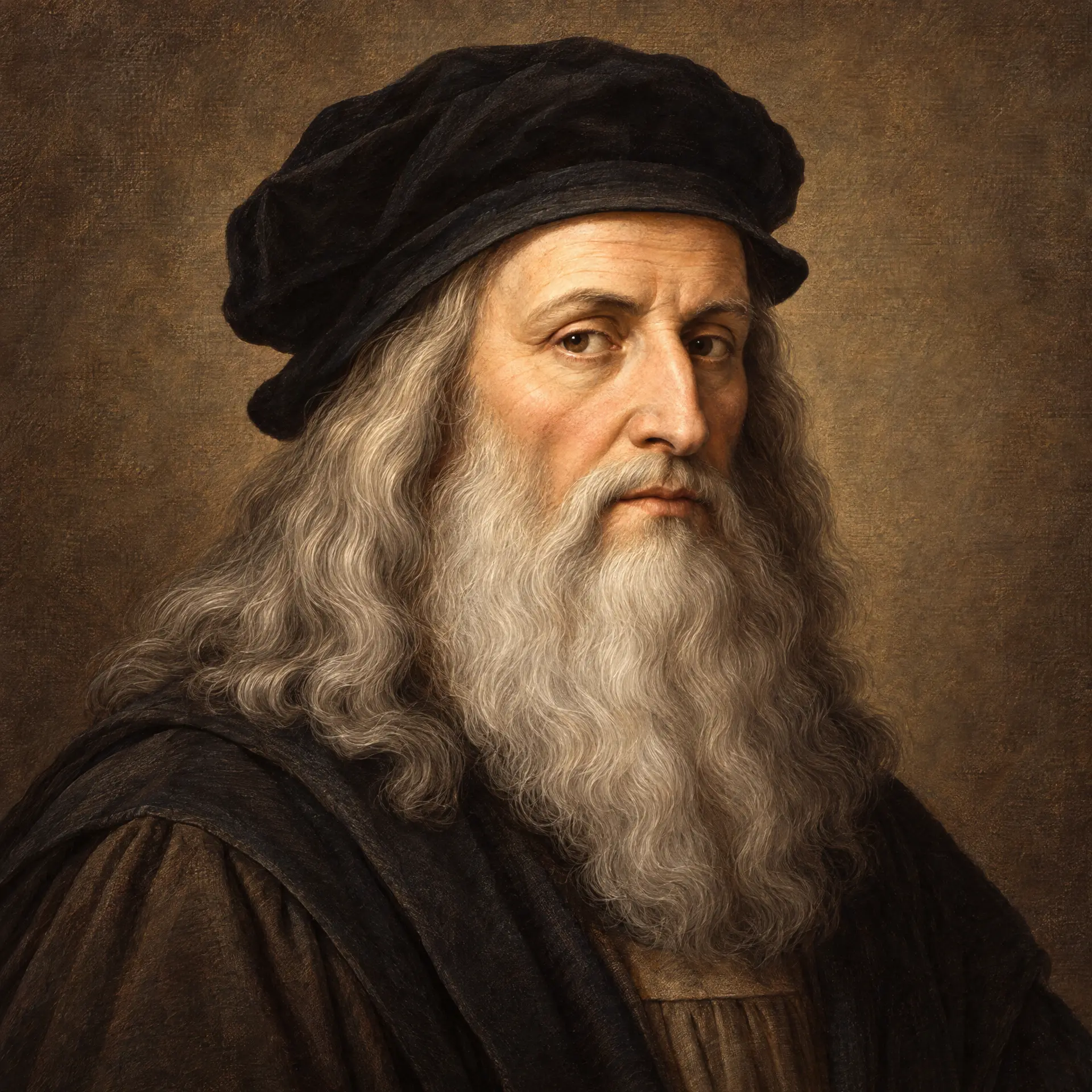
01 / THE TEACHER
The Teacher
& His Legacy
Leonardo da Vinci (1452–1519) was an Italian artist, inventor, engineer, anatomist, and investigator of the natural world whose extraordinary curiosity crossed nearly every boundary of Renaissance knowledge.
Best known for masterpieces such as the Mona Lisa and The Last Supper, Leonardo also left thousands of pages of notebooks containing studies of anatomy, mechanics, flight, water, geometry, architecture, and the natural world.
He believed that understanding began with careful observation. Through drawing, experimentation, mathematical reasoning, and persistent questioning, he sought to uncover the principles underlying both living organisms and mechanical systems.
His notebooks reveal a mind continually exploring connections between subjects that others often treated separately.
Meet Leonardo da Vinci02 / THE APPROACH
How These Teachings
Were Developed
Leonardo da Vinci — The Art of Seeing
This Legacy Teachings series draws upon Leonardo's surviving notebooks, scientific investigations, anatomical drawings, engineering designs, writings on painting, and documented creative work.
Rather than presenting Leonardo simply as a great historical figure, the series explores the methods of observation, investigation, invention, and visual reasoning demonstrated by his work.
The lessons are developed from documented historical sources, supported by scholarly interpretation, and connected to practical applications for modern learners.
03 / ENDURING IDEAS
What Leonardo da Vinci Can Teach Us
The Science of Observation
Learning to see carefully, recognize patterns, question assumptions, and investigate the world through direct observation.
Invention and Engineering
Understanding mechanisms, breaking problems into components, exploring alternative designs, and reasoning about how things work.
The Human Body as a System
Exploring anatomy, movement, proportion, and the relationship between physical structure and function.
Art as a Method of Inquiry
Using drawing, perspective, light, shadow, and composition to understand and communicate the visible world.
Nature as a Teacher of Design
Discovering how the structures and movements of natural systems can inspire human inventions.
Learning How to Learn
Developing curiosity, maintaining notebooks, asking useful questions, and pursuing knowledge across disciplines.
Systems Thinking and Interconnected Knowledge
Recognizing relationships between seemingly unrelated subjects and understanding how individual parts contribute to larger systems.
Creativity and Practical Problem-Solving
Turning observations into ideas, evaluating possibilities, and communicating solutions through visual and technical design.